This is a brief résumé of the major work and development carried out during the past 20 years to make A2ROV such a successful speed event car.
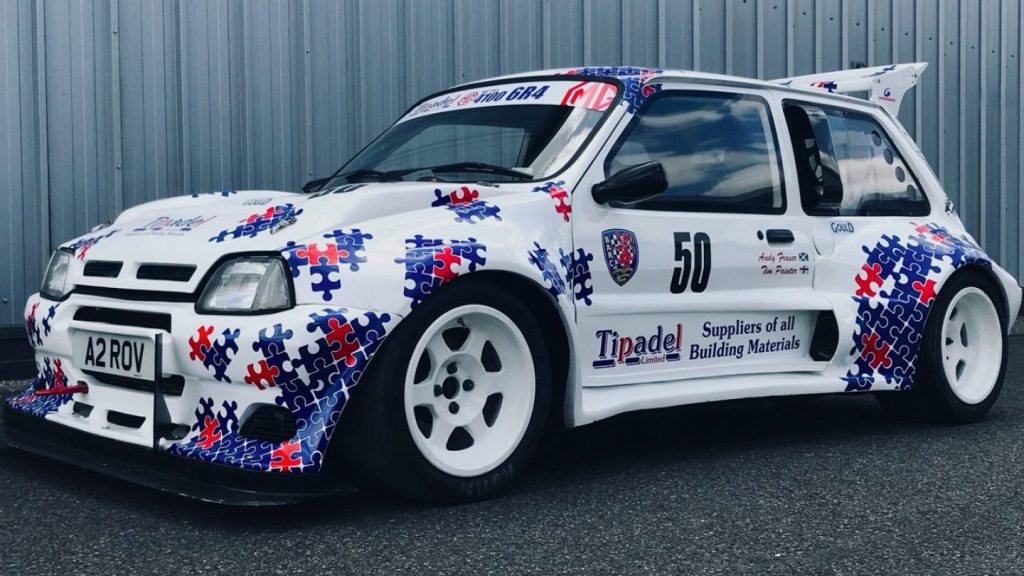
This legendary Group B Rally Car has been developed specifically for Speed Hillclimbing and Sprinting and has been successfully campaigned by Tim Painter and Andy Fraser since 1993
March 1993
This interesting car, designated chassis number 10, was originally purchased from David Appleby Motorsport (DAMS) of Malmesbury, Wiltshire, as a road registered car, complete with a standard 6R4 clubman’s engine and synchromesh gearbox. This car was also fitted with TPR4100 carbon/kevlar bodywork, which was developed by Tony Pond Racing for Rover Motorsport and manufactured by Dove Engineering in Hampshire. It became one of the 7 or 8 cars to be built with this style of bodywork.
Winter 1993 – 1994
After a trial season campaigning the car, it was completely stripped and rebuilt and fitted with the following modifications:
International Spec Engine – ex Hans De Pas / Will Gollop – this engine was developed by Cliff Humphries at Rover Motorsport and fitted with Jack Cramp cylinder heads.
Dog Gearbox – Lowered ride height with softer spring rates – Suspension modifications – front chassis modification to incorporate a deformable structure for quick component replacement and easy access for maintenance – strengthened suspension mounts front and rear – steering column strengthened – roll cage modified – electrics updated and complete car rewiring with new bespoke loom.
The basic colour scheme was changed from dark blue to white with the distinctive jigsaw graphics applied.
Winter 1994 – 1995
Complete overhaul of gearbox, differentials, brakes and suspension components Modifications to seats, gearbox, gear selector mechanism, transfer gears, front and rear differentials, fuel and oil supply lines. New repackable stainless steel exhausts fitted.
Aero package, splitter and diffuser, developed and fitted.
Summer 2010
Rear differential casing replaced with heavy duty version from R&D Motorsport along with crown wheel and pinion.
February 2011
Engine removed, then stripped, checked and rebuilt by John Mankelow (Ex Goodman Race Engines) Complete check and overhaul of all transmission, suspension and mechanical components.
January 2013
DTA ECU fitted with new engine loom and coil over plug update.
Many modifications have been carried out at this time, and with successful improvements to the oil and water cooling systems.
Metro 6R4 performance stats
C. 420bhp @ 9,500 rpm
0 – 30 mph….. 1.1 secs / 0 – 50 mph….. 2.2 secs / 0 – 60 mph….. 3.0 secs / 0 – 100 mph …..8.0 secs
From the Archives……..
A brief history of the MG Metro 6R4
1981 – British Leyland Motorsport Division headed by John Davenport together with Patrick Head of Williams Grand Prix Engineering planned a new Group B Rally Car. It was to promote British Leyland launch of their new Mini Metro car.
Work began that year on the chassis design, which was to incorporate a mid-engine 4-wheel drive layout. The car design was completed in 1982 and with further development work allowing it to be unveiled in 1984 as a rally winning Group B car.
While Williams were concentrating on the chassis development, Austin-Rover was busy developing their own normally aspirated 90 degree V-6 engine. A modified Rover V8 engine was used for the initial testing of the car.
This comprised of a cut down version, basically with two cylinders chopped off and designated V62V (V-6 Two valve per cylinder).
Eventually, the final V-6 24 valve engine was produced with most of the top end machining work deriving from Cosworth Engineering. First impressions of this engine will show the similarity to the Cosworth DFV, and in fact a lot of the components of the valve gear, breathing arrangements and even the pistons was lifted’ from this legendary engine.
Dispelling all previous myths, this very successful engine, designated V64V bears no resemblance to the Rover V8 engine, the only common factor however being the 90 degree Vee configuration. They were manufactured in two versions: 1986 saw the 410bhp International for Rally and Competition use, although a cheaper Clubmans version, producing only 250bhp, was produced to enable Austin Rover to complete the required 200 cars for homologation at their Longbridge factory by 1st November 1985. Transmissions were manufactured by FF Developments. Tony Pond
Tony Pond debuted the 64 on the 1985 RAC Rally in November finishing 3rd overall, and when the International engine was made available the following year, the car achieved numerous European Championship wins.
Later in 1986 Group B Rally Cars were banned after tragic accidents in Corsica and Portugal. Also banned were the Ford RS200, Peugeot 20516 and the Lancia Delta S4. Austin Rover Leyland became disillusioned and disposed of the remaining stock of homologated cars at an enormous loss and it was reputed that they could be purchased for as little as £15,000 – £17,000. Many of the original 200 cars have now been written off.
The ‘new shape’ TPR4100 bodywork fitted to some of the later 6R4 cars was developed by Tony Pond Racing and was available from David Appleby Motorsport. It is manufactured from a carbon/kevlar material, much lighter and stronger than the original glass fibre construction and aerodynamically superior to the original box shape of the earlier models.
The cars ex Leyland in 1985 cost £34,783.61. With the works International engine fitted the cost went up to £46,783.61.
 Shed Motorsport